AI-Driven Transformation in Arts Education and Future Talent Development 人工智能赋能艺术教育转型与未来人才培养国际学术研讨会

atsa
2026-02-09
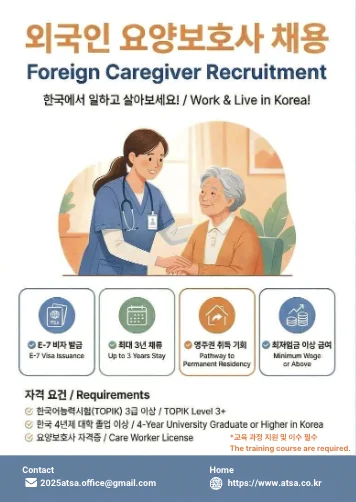
As South Korea faces a rapidly aging population, the demand for professional caregivers has reached an all-time high. For many years, this field was strictly limited to Korean citizens or specific visa holders (like F-4 or F-5). However, as of 2026, the doors have swung wide open for international students (D-2) and job seekers (D-10) through the new E-7-2 specialized visa pathway.
If you are a foreigner studying in Korea and looking for a stable career with long-term residency prospects, this guide will explain exactly how you can become a certified caregiver and secure your future in Korea.
Starting in early 2026, the South Korean government officially launched the "Foreign Caregiver Training University" pilot program. This initiative, involving 24 designated universities nationwide, allows international students to undergo specialized training and transition directly into the workforce. This marks a significant shift from past policies where simple labor was discouraged for D-2 holders.
Not every foreigner can immediately work as a caregiver. To maintain Expertise and Trustworthiness (E-A-T) in the healthcare sector, the Ministry of Justice requires specific qualifications:
You must hold at least an Associate Degree (전문학사) or higher from a university in South Korea. Students currently enrolled in the designated 24 pilot universities have the smoothest path, as their curriculum is integrated with the national certification requirements.
You must pass the National Caregiver Certification Examination. Previously, international students were often restricted from taking the required 320 hours of training, but 2026 regulations now allow D-2 and D-10 holders to enroll in these courses at authorized training centers or their universities.
Because communication with the elderly is critical, you must satisfy one of the following:
The most crucial step for long-term employment is securing the E-7 (Specific Activities) visa, specifically the E-7-2 (Caregiver) sub-category. This visa allows you to work legally in elderly medical welfare facilities (nursing homes).
Important Note: The employment must be at a "Nursing Home" or "Elderly Medical Welfare Facility" as defined under Article 34 of the Senior Citizens Welfare Act. Small-scale group homes (under 9 residents) might have different quota restrictions.
Follow these steps to transition from a student to a professional caregiver:
Working as a caregiver in Korea is no longer just a "part-time job"—it is a professional career path with a clear residency trajectory. By leveraging the 2026 pilot programs and the E-7-2 visa, international students can solve their visa concerns while contributing to Korean society.
Are you ready to start your career in Korea's healthcare sector? Check if your university is one of the 24 designated training institutions today, and ensure your TOPIK score is up to date.
Inquiry Deadline
June 15
For more detailed inquiries regarding individual visa scores or specific contract reviews, we recommend consulting with a certified immigration lawyer or visiting the official HiKorea portal.


If you have any questions, feel free to contact me anytime.